Showing posts with label physics. Show all posts

Friday, January 17, 2014

Faculty and students present research at national physics teacher conference

Three Randolph College students and one faculty member recently presented research at the American Association of Physics Teachers national meeting in Orlando, Florida.

Tim Slesinger '14, Chris Holingsworth '15, physics professor Peter Sheldon, and Jim Kwon '14

Chris Hollingsworth ’15 presented research he conducted with Zahra Adahman ’14, Alex Kwakye ’15, and physics professor Katrin Schenk. Their work delved into understanding communication deficits in mice as a way of understanding human communication disorders.

Jim Kwon ’14 presented research done with professor Evan Goulding at Northwestern University, in conjunction with a project involving other Randolph students and Schenk. His presentation, "Behavioral Analysis Techniques for Mobile Phone Collected Data," explores ways of using cell phone accelerometer data to determine the physical activity level of the person carrying the phone.

Kwon also presented research done by students Sydney Henson ’14 and Katherine Lesnak ’15, along with physics professor Peter Sheldon, education professor Peggy Schimmoeller, and biology instructor Amanda Rumore, "Science and Math Links: Research-Based Teaching Institute," is an annual project that looks at the impact of hands-on science teaching on learning.

Tim Slesinger ’14 presented "Investigating Traditional Methods of Inertial Navigation versus Using a Smartphone," research he conducted with Alex Tran '15, Kacey Meaker '08, and Sheldon.

Sheldon gave a presentation about Step Up to Physical Science and Engineering at Randolph (SUPER), a Randolph program that is helping to increase enrollment of students committed to careers in science, mathematics, and engineering. Funded with a $600,000 grant from the National Science Foundation, SUPER provides some scholarships and additional educational activities for Randolph science students.

Monday, December 16, 2013

Randolph physics students organization wins national award

The Randolph College chapter of the Society of Physics Students (SPS) has been recognized again as one of the best SPS chapters in the nation.

This month, the national society honored the Randolph chapter with an Outstanding SPS Chapter Award. Fewer than 10 percent of SPS chapters, or about one per state, receive this designation. Randolph’s chapter has earned the title for eight out of the past nine years.

“I am proud of these students for yet again earning this Outstanding Chapter award,” said Peter Sheldon, a Randolph physics professor and advisor to the SPS. “This acknowledges their work in conducting research and in teaching the community about science.”

Randolph’s SPS organizes and runs the annual Randolph College Science Festival, which attracts more than 1,000 people to various events that celebrate science and teach about its connection to all aspects of life. The students also host events for other Randolph students and work on “build projects,” such as a giant Newton’s cradle—with bowling balls suspended from a wooden frame—that the group has been building this semester.

The award letter from Toni Sauncy, director of SPS, specifically mentioned the Science Festival and a science Jeopardy activity as reasons for the Outstanding Chapter designation.

“You and your officers have earned a moment in the spotlight to recognize the efforts that you make to build community and propel students into their careers as prepared professionals,” Sauncy said in the letter.

Tuesday, August 27, 2013

Local mentors meet Randolph science students

Participants in Randolph College’s summer program for first-year science, math, and engineering students recently met mentors who will provide advice and direction as the students advance through science programs and pursue careers.

Genevieve Neale '93, right, talks with Anthony Quinn '17, a student she will mentor
as part of the SUPER program for students interested in science careers.
The students and mentors held their first meeting at lunch on Monday. They will continue to meet throughout the academic year so the mentors can help the guide the students toward their goals.

Mentorship is an important part of Step Up to Physical Science and Engineering at Randolph (SUPER), a program funded by the National Science Foundation. The program aims to help students excel in science and engineering curricula and pursue crucial careers.

Kelly Hazlegrove, an environmental scientist at the Virginia Department of Environmental Quality, said she enjoyed the opportunity to meet the SUPER student she will mentor. She added that she sees this as an opportunity to help students turn an interest in science into a life direction. “At that age, they might not be aware of the career paths available to them. This will open doors for them,” Hazlegrove said. “The mentoring can help guide them in their studies.”

Sienna Brown '17 talks with her mentor in the SUPER program.
Three alumnae of the College are serving as mentors for the students: Rebecca VanWitzenburg Skeen ’05, a research and development chemist at C.B. Fleet; Ruth Herbert Maragni ’80, a registered nurse and human resources official for Centra Health; and Genevieve Neale ’93, owner and veterinarian for Paw Prints Mobile Medicine for Pets.

“We have matched each SUPER student with an industry professional who works in a career in which the student is interested,” said Peter Sheldon, a Randolph physics professor who directs the SUPER program. “We expect that the mentors will become a friend, a guide, and a resource that will help our students find their way to their passion. We expect that these mentoring relationships will aid our students in finding their career path, will help to provide them with meaningful internships, and will ultimately lead to a career in science.”

Monday, July 8, 2013

Students continue studying inertial navigation

Tim Slesinger ’14 continued research this summer to find a way to turn one of the most common electronic devices into a powerful navigational tool.

Last summer, he began working with Peter Sheldon, a Randolph physics professor, to find a way to use smartphones and other common electronic devices for inertial navigation, a process which tracks an object’s speed, direction, location, and orientation using only physical forces generated by the motion rather than outside sources such as GPS satellites. They used an iPod Touch to record accelerometer data while riding roller coasters, and then Slesinger worked with that data to try extrapolating the roller coaster’s route.

This summer, Alex Tran ’15 joined the project. They focused on more basic experiments to determine how they can most accurately record and analyze accelerometer information. Most of their experiments involved a one-dimensional motion created by pushing a wheeled cart along a short track.

“We do it over and over again so we can take more data,” Tran said. “The data is very complex. We have to get rid of the noise and estimate the position as best as we can.”

The students used several devices to push on the cart and record accelerometer data so they could see what type of accelerometer was most accurate. “We noticed the accelerometer on the fourth-generation iPod Touch is much better than on the second generation,” Slesinger said. Both recorded data with less noise—which could be caused by magnets or external vibrations—than a professional grade accelerometer. A Samsung Galaxy S3 smartphone had the best accelerometer of all the devices they tested.

If the research team comes up with a reliable way to do inertial navigation with these more affordable devices, it would open up more possibilities for physics teachers to do advanced experiments with their students without breaking the bank.

They also recorded video of each experiment this summer, allowing them to verify whether the cart was traveling at the same speeds that their calculations indicated, and they explored how to incorporate data from the devices’ gyroscopes.

The one-dimensional test is less exciting than a roller coaster, but Slesinger said it will allow him and Tran to perfect the method of processing the accelerometer readings. Then a three-dimensional map would be more attainable. “If we get a perfect, ideal program for the one-dimensional navigation, it will be miles easier to go into the complexity of a three dimension system,” he said.

Wednesday, June 12, 2013

Randolph student develops business plan for local food hub

Tu Nguyen ’15 is developing a plan to help grow business for a local nonprofit that grows organic food.

Two days a week, Nguyen bikes about five miles from the Randolph campus to Lynchburg Grows, an urban farm that provides education programs and grows produce to sell in the region. He became acquainted with Lynchburg Grows last semester while taking “Economics of Food and Sustainability,” a class which studies the economic and social factors related to food production and distribution. Impressed by the operation, Nguyen sought an opportunity to work with the organization. “I sent an e-mail to Lynchburg Grows and asked if they had some internships I could do,” he said.

It turned out that there was an opportunity. The nonprofit needs a business plan for establishing a local food hub that would help local farmers sell produce to large customers such as hospitals and schools. “It would be a cross between a farmer’s market and a wholesale distributor,” explained Nate Foust-Meyer, the Lynchburg Grows farm manager and Nguyen’s supervisor. “It’s a model for bringing local farmers together.”

Having Nguyen handle the economic analysis and write the business plan will allow the project to move forward faster while allowing Foust-Meyer and other staff to focus on the farm operations. “It plays to his strengths and what he’s happy doing,” Foust-Meyer said.

Most of Nguyen’s time is spent crunching numbers, such as the cost of growing produce and the wholesale prices that the target market would be willing to pay. But he occasionally takes a break from the business plan to pull weeds and plant seeds in the Lynchburg Grows greenhouses.

Nguyen also is working in another internship, doing marketing work for a local financial planning office which he discovered through Randolph’s Experiential Learning Center. The two internships together are teaching him lessons that he would like to apply someday in a career as a financial advisor. “I am learning how a real business works,” said Nguyen, who is majoring in economics, mathematics, and physics. “This will be a really good experience for me.”

Tuesday, June 11, 2013

Student looks to the skies in astronomy research project

If scientists ever discover a giant asteroid on a collision course with our planet, they will owe a lot of their information on the asteroid to the observations of amateur astronomers such as Hart Gillespie ’15.

Gillespie is conducting a Summer Research project at Winfree Observatory, Randolph College’s 90-year-old observatory with a 14-inch telescope. He hopes to record an asteroid occultation and submit the data to an international database that helps scientists track asteroids.

An asteroid occultation is an instance when an asteroid passes between the earth and a star, blocking part or all of the light. An astronomer can observe that part or all of the star disappears momentarily, ranging from a split second to as long as 20 seconds. This can provide valuable information on an asteroid that is otherwise invisible.

“All you need is one occultation to see that the asteroid was there, but you would know where it was in only one instance in time,” said Gillespie, a physics major. “You would have no idea where it’s going, or how fast it is going, and you would not know the shape of the asteroid.” Those additional details can be pieced together as astronomers from many locations track occultations and send their data to the International Occultation Timing Association.

Gillespie’s plan is to pay attention to asteroid occultation predictions, usually published about a week in advance of a potential occultation, to schedule time to work in the observatory in hopes of viewing an occultation.

Observing occultations has been more difficult than Gillespie had anticipated, mainly because of weather conditions over the past several weeks. “I’ve learned it's cloudy a lot, so maybe I should go into radio astronomy,” he said.

While waiting for clear skies, Gillespie has been working with the College’s facilities staff on plans to improve the observatory facility with an electrical upgrade, scaffolding that will make the telescope easier to use, and a first-floor classroom area. He hopes the changes will make Randolph College Star Parties, held about once a month, more enjoyable for amateur astronomers in Lynchburg and more useful for physics education at Randolph.

Wednesday, February 27, 2013

Scientist who helped discover the Higgs boson to kick off Randolph Science Festival

A scientist involved in one of the most important recent scientific discoveries will headline the Randolph College Science Festival in March.

Don Lincoln, a Fermilab scientist, will present the Science Festival’s keynote address, “Fireworks in July – An Insider’s Account of the Discovery of the Higgs boson,” at 7:30 p.m. on March 21. It will kick off four days of events that help people of all ages learn about—and have fun with—science.
The Randolph College Science Festival helps people discover the science that powers innovations we all love. Find out more on the Science Festival website, or read a detailed list of events below.

Lincoln worked on the team of scientists that used the Large Hadron Collider in Europe to test for the existence of the Higgs boson, a subatomic particle that is important to scientific theories about the beginnings of the universe. Last summer, the team announced that it had discovered what appeared to be a Higgs boson.

“The discovery of the Higgs boson is probably the biggest scientific discovery of the century,” said Peter Sheldon, a Randolph physics professor who organizes the Science Festival. “The large-scale science Dr. Lincoln is here to talk about impacts everyone, and he is able to really bring it to life.”

Lincoln is known for explaining deep scientific principles in a way that is easy for non-scientists to grasp—for example, he has written books and delivered a TED Talk about the Higgs boson, and also has a YouTube video with more than a million views. “He is able to show the beauty and express the importance of this and other discoveries,” Sheldon said. “He is a speaker you do not want to miss.”

After Lincoln’s keynote address, Science Festival will continue on Friday when Lincoln leads a class at Randolph College at 11:30 a.m. Members of the public may attend if they contact Sheldon in advance as seating is limited.

Other Science Festival events this year include:

Friday, March 22

The Center for Student Research Open House—Come learn about student research opportunities and achievements at Randolph College. 2:30 p.m., West 106
Women in Science Panel—Learn about how the College’s alumnae have built careers in science. 3:30 p.m., Nichols Theatre, Student Center
Poetry Competition Reading—More than 1,000 students have submitted science-themed poems to this year’s contest. 6:30 p.m., Wimberly Recital Hall, Presser Hall
A Scientist Goes to the Movies: The Avengers—Randolph mathematics professor Marc Ordower will dress as Nick Fury and offer scientific commentary about this popular film. Wear your own superhero costume for a chance to win a prize! 8 p.m., Nichols Theatre, Student Center

Saturday, March 23

Science Day Fun for Little Scientists—Randolph students will lead children in age-appropriate science-based activities at the Randolph College Nursery School. Noon and 1:30 p.m. (Requires pre-registration.)
Science Day—This popular event will include science-based activities for students in grades 3–6. (Requires pre-registration.)
Star Party—View stars, planets, and other astronomical bodies at Winfree Observatory. In the event of rain, a slideshow will be shown. 8:30 p.m.

Sunday, March 24

Art and Animals Drawing Contest—Draw animals from the College’s collection of birds and mammals. 1–3 p.m., Martin Science Building
Drop-in Science Activities—Science demonstrations including robots, lasers, nature, and more. 1–3 p.m., Martin Science Building
Pinewood Derby Regional Competition—We host this annual race for the Cub Scouts again. 1–4 p.m., Houston Memorial Chapel

Friday, October 26, 2012

Students present research at conference for women in science

A recent nationwide conference honoring college women for their accomplishments in science included two Randolph College students.

Zahra Adahman ’14 and Chiamaka Asinugo ’14 were selected to present their research in the Conference of Undergraduate Women in Physical Sciences at the University of Nebraska-Lincoln.

Chiamaka Asinugo ’14 presents earthquake research at the Conference of
Undergraduate Women in Physical Sciences at University of Nebraska-Lincoln.
“It was such a great environment to have all these women and be able to sit down and talk about physics, and about science in general,” Adahman said.

Asinugo said she applied to present at the conference at the suggestion of Tatiana Gilstrap, a physics and environmental studies professor with whom she conducted research this summer. She was honored and humbled to be chosen to attend.

“There are so many research programs being conducted, and I have come to find that every contribution—no matter how little—is vital on the broad scale,” Asinugo said.

Asinugo presented research from her summer project with Gilstrap. They analyzed seismic data from several earthquakes, including the aftershocks following the August 2011 earthquake in Virginia.
Zahra Adahman ’14 presents her research about the ultrasonic  mouse vocalizations

Adahman gave a 15-minute talk about research she has conducted with physics professor Katrin Schenk for the past two years. They are studying the ultrasonic vocalizations of mouse pups and the ways that mouse mothers respond. They hope to learn things from studying the mice that could shed light on autism and other communication disorders that affect humans.

“My long term goal is what really keeps me into science. I want to be a doctor,” Adahman said. “Research is very important in medicine, and I want to be involved in it.”

Thursday, August 9, 2012

Physics research on roller coasters

Tim Slesinger ’14 boarded Dominator, a popular roller coaster at King’s Dominion that reaches nearly 70 miles per hour. Like other riders, he was seeking thrills from the speed, twists, turns, and dives.

Unlike others, he was seeking scientific data.

This year, Slesinger joined an ongoing research project on the physics of roller coasters. Several years ago, Peter Sheldon, a Randolph physics professor, and Kacey Meaker ’08 set out to use scientific equipment to measure the speed, acceleration, and other forces experienced by roller coaster riders. They have been working on a book that uses roller coasters to explain physics to a mass audience.
How does riding a roller coaster connect with scientific
research? Watch this video to learn how a Randolph professor,
student, and graduate explore the physics of roller coasters.

“The project started because I really like roller coasters,” said Meaker, now a Ph.D. candidate at the University of California at Berkley.

As Dominator shot forward, Slesinger raised his hands in the air and cheered along with other riders. Meanwhile, an iPod Touch in his pocket recorded measurements from its accelerometer, an internal device that detects orientation and motion.

He said that his goal was to find out if the accelerometer could be used to perform inertial navigation—like a four-dimensional GPS that doesn’t need satellites.

Sheldon explained that airplanes and large boats use inertial navigation regularly with the help of expensive equipment that tracks exactly where they are—including latitude, longitude, and elevation—at any given point in time. But that equipment is so expensive that inertial navigation is out of reach for educational applications.

“Physics teachers have, for years, taken their students to ride roller coasters, but they really can’t do a lot of useful measurements,” Sheldon said. “We’re trying to develop a way to do inertial navigation on a small, less expensive scale. We’re trying to develop methods that would allow people to do this in the classroom.”

This summer, the research team rode roller coasters while carrying iPod Touches and gyroscopes as well as real inertial navigation equipment. Slesinger then compared readings from devices to determine whether the data from the accelerometer and gyroscope could map the same travel path recorded by the expensive equipment.

“Mostly, we want to be able to know that we can do inertial navigation with these devices,” Meaker said. Slesinger added that inertial navigation could have many applications in high school and college physics classes if it can be performed with affordable equipment.

The calculations showed that accelerometer data can map out an accurate path with enough computation, but this fall, the project will be continued in hopes of more detailed findings.

The Summer Research project was a good opportunity to learn more about the research process and practice computer programming, Slesinger said. It also strengthened his appreciation for the educational environment at Randolph College. “You really get to know professors here on a personal level,” he said. “It doesn’t feel like college, but it feels like family when you’re learning.”

Meaker agreed with that sentiment. “Every summer I’m lucky enough to get to come back,” she said. “It’s like I’m coming home.”

Monday, February 27, 2012

Society of Physics students wins national recognition for the sixth year running

The annual Science Festival, where Randolph College students lead science demonstrations
and activities for children, teenagers, and adults, helped the Randolph chapter of the Society
of Physics Students win an Outstanding Chapter designation again.
Randolph College's physics students stay on the move: Throughout the year, you can find them fine-tuning potato guns, riding roller coasters to explore the physics at play, or helping Cub Scouts perfect their Pinewood Derby cars.

Those activities and outreach efforts have again caught national attention. The national office of the Society of Physics Students national office has just awarded the Randolph College Chapter with the Outstanding Chapter status for the sixth year in a row.

The Randolph College Chapter of the Society of Physics Students works on a variety of projects. Its largest activity is the annual Science Festival, when the College hosts science activities and demonstrations for people of all ages with the help of more than 90 student volunteers. This year's Science Festival will take place March 22 - 25.

This year, the group also plans to build a canon that will shoot T-shirts out to fans at Randolph College athletic events. They just do not stop!

Tuesday, August 9, 2011

Lynchburg youth get taste of science at Randolph College

Excitement for science was palpable Tuesday afternoon as participants in Lynchburg Parks and Recreation summer programs came to Randolph College to learn about electricity.


Peter Sheldon, a physics professor, showed the children how electricity from Tesla coils and Van de Graaff generators—also called lightning machines—interacts with packaging popcorn, pie plates, and human hair.


Sheldon encouraged the students to attend the College's Science Festival, scheduled for March 23—25 next year, to participate in more cool science experiments.

Friday, January 14, 2011

Get Ready for Randolph ScienceFest

The Randolph College Society of Physics Students is proud to bring you the Second Annual Randolph College Science Festival, March 25-27, 2011.

Begun as a Science Day for kids in 2005, we are joined by science, humanities and arts departments across the campus, and by numerous presenters to bring a weekend of activities for all.

All activities are free and open to the public, and are for all ages.

Learn more at www.RandolphScience.org

Thursday, December 17, 2009

Physics Club Wins National Award


The Randolph College chapter of the Society of Physics Students (SPS) has been named an Outstanding Chapter by the National Society of Physics Students for 2008-2009.

This is the fourth national Outstanding Chapter award for the club, having earned the honor in 2004-05, 2005-06 and 2007-08.

"We have an outstanding group of students who are passionate about physics," said faculty advisor Peter Sheldon, professor of physics. "We won this award because of their dedication to bringing science to the public."

The award is the culmination of a very eventful 2008-09 academic year for the group.
  • The chapter won the 2008 Blake Lilly Prize for their work with Randolph's annual Science Day for local elementary school children. That event also won them the Randolph College award for Best Philanthropic Event.

  • SPS hosted activities for all students including field trips to an amusement park to enjoy the physics of rollercoasters and the Smithsonian Institution, a photo contest, a project to design and build a t-shirt gun, and a Wii tournament.

  • In addition, four physics majors received travel grants from SPS National to attend and present research at the American Physical Society National Meeting.

  • SPS President Wai Sze Cheung, with the help of SPS, coached a group of children in the FIRST Robotics tournament.

  • SPS ran the Lynchburg area’s first Science Festival, and their signature event, Science Day, attracted about 300 children, teachers, and their families.

  • Randolph hosted the Society of Physics Students’ Zone 4 Meeting, a regional student physics conference.

Sheldon praised the 2008-09 officers of the SPS for their leadership and all the clubs members for their enthusiasm They were ...

  • President: Wai Sze (Winncy) Cheung
  • Vice President: Tiffany Paonessa
  • Secretary: Catherine Khoo
  • Treasurer: Yanpaing Oo
  • Historian: Nema Marjana

Links

Tuesday, December 1, 2009

Peter Sheldon Named Finalist in National Competition

Randolph College physics professor Peter Sheldon has been named a finalist in the national Society of Physics Students (SPS) Outstanding Advisor award competition.

Sheldon is one of just 18 professors nationwide chosen in the competition. The winner will be announced during the winter meeting of the American Association of Physics Teachers.

Professors are chosen for the award through a competitive nomination process. The Award Committee chooses the national winner based on leadership, student leadership development, support, and the encouragement provided by the advisor.

Gary D. White, director of the SPS said the professors chosen to be finalists “represent the best of those that serve as mentors to physics students.”

In addition to leading Randolph College’s active SPS chapter, Sheldon serves as director of the dual-degree engineering program, the Summer Research program, and is assistant coach of the men’s and women’s cross country teams.

Saturday, November 21, 2009

Physics Students Teach Cub Scouts the Science of Speed

Members of the Randolph College Society of Physics Students spent their Saturday morning with the Cub Scouts of Pack 48. They conducted a hands-on workshop, applying the lessons of physics to build faster Pinewood Derby race cars.

A longtime scouting tradition, the Pinewood Derby challenges scouts to build a wooden race car from a standard kit and then race them on a track. The competition begins within a pack and carries over to regional councils.

Professor Peter Sheldon and his students gave a physics lesson on how weight, gravity, speed, stability, friction, drag and other variables affect a car's performance and then broke out into groups to test different designs and setups.

Read more > > >

Friday, October 30, 2009

Video: Kacey Meaker

Alumna Kacey Meaker talks about how Randolph College prepared her for her doctoral work in physics. She describes the research she conducted as an undergraduate student with professor Peter Sheldon on the physics of rollercoasters which led to their co-authoring a book on the subject.


Watch more Randolph College videos > > >

Wednesday, September 2, 2009

Physics Professor Peter Sheldon Wins Larew Award

Physics professor honored for distinguished teaching.


Professor of Physics Peter Sheldon

Professor of Physics Peter Sheldon is the 2009-10 recipient of the Gillie A. Larew Award for Distinguished Teaching.

The honor was announced during Randolph College's Convocation ceremony on September 1, 2009.

The award is given annually to a member of the Randolph faculty who has demonstrated excellence as a classroom teacher.

In presenting the award, Dennis Stevens, vice president for academic affairs and dean of the college, praised Sheldon for his commitment to teaching in and out of the classroom. "He challenges students to see the world around them in new perspectives. His students talk about the excitement of seeing the practical application of theory."

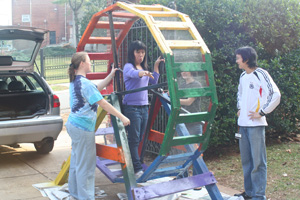
Sheldon is active throughout the campus - from building a human-sized hamster wheel with the Society of Physics Students to launching projectiles across the quad during class. He is active in the College's Summer Research Program, working with a student on a book about the physics of roller coasters, as well as other projects.

An avid runner, Sheldon serves as assistant coach to the men's and women's cross country teams and in August 2009 finished his first Ironman Triathlon.